 |
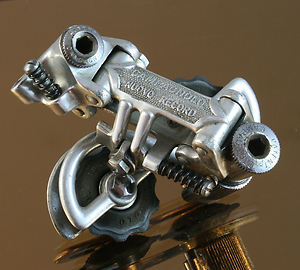
| Campagnolo Nuovo Record |
The history of bicycle drivetrains has been extensively documented in both “The Dancing Chain: History and Development of the Derailleur Bicycle” by Frank Berto and “Bicycle: The History” by David V. Herlihy. There are many other books concerning cycling’s early years, but what I’m more interested in is the future of bicycle drivetrains.
I’m not an engineer by any stretch of the imagination, but I would like to engage in a bit of speculative fiction. Over the weekend I got a chance to try a bike that was outfitted with the Pinion P1.18 transmission that was paired with a Gates Carbon Drive belt drive. The Pinion P1.18 is an expensive piece of equipment that requires a frame made specifically to house the internal gear system, so the buy-in cost is pretty high right now. But it is a tantalizing glimpse into what may be around the bend in terms of new designs.
I will say the Pinion P1.18 had a lot going for it—reasonably low weight, 2.698 g for the gearbox, 95 g for the shifter; but detractors will say you need a specially made frame for the Pinion P1.18. In case you hadn’t been paying attention, every bicycle needs a specially made frame for its associated drivetrain. The key difference is once you buy into the P1.18 system you are kind of stuck with it; but if it became a standard drivetrain system, that may be a non-issue.
The P1.18’s nearest relatives are the Rohloff Speedhub and the Shimano Alfine internally geared hub systems. Unlike the P1.18 the business end of these systems is located in the rear hub, not the bike’s frame. The advantage, of course, is that both the Rohloff and the Shimano systems can somewhat be easily mated with a fairly standard bike frame. That’s a plus in itself because, in theory, an old unused bike can be brought back to life with a new transmission.
I’ve spent a fair amount of time with the Shimano Alfine and it works pretty well. Curtis Inglis of Retrotec put one on the back of one of his mountain bikes and put it through the paces. He’s a big guy and he rides hard, so if it held up under him that’s a pretty good sign. My main complaint about the system is that it has a maximum of eleven gears. And while it may not be that big of a deal on a basic commuter bike, it may be far from optimum for off-road riding. The other is that it’s a pain in the butt in order to assemble and disassemble the fiddly activation cable for the transmission system. I will say it’s a shame that the Alfine system didn’t continue to use the Bell Crank system that the Nexus hub had on it because it was a lot easier to futz around with.
Apparently that’s less of an issue with the Rohloff Speedhub, but both the Speedhub and the Alfine have the same issue—they both put all the weight in the rear wheel, meaning that it throws the balance of the bike far behind the bottom bracket, making for some odd handling characteristics.
The chain has been one of the weakest links of the bicycle drivetrain. Subjected to enormous loads, contamination, and oxidization, a bike’s chain is always on the brink of disaster. Even though the Gates Carbon Drive Belt System is about as far away from upturning the chain’s apple cart as I am of becoming the next TDF winner, it is gaining traction and may be a viable option in the near future.
That said, however, I can’t see the Gates Carbon Drive Belt System replacing the chain any time soon. The high-end road bike market is obsessed with shaving every gram humanly possible and has also now almost universally embraced electronic shifting systems. Good news for people that were confused by Shimano STI or Campy Ergoshifters, bad news if you have any “green” sensitivity. It seems to me that the industry is more than happy to say, “Just a few little poisonous batteries waiting to spoil your water supply, nothing to worry about. Move along, move along.” I suppose that sort of denial also enables them to sleep at night using cheap labor in countries that have poor environmental records—talking about you Malaysia.
Here are my predictions:
1) Lower end bikes will continue to use chains and cable activated derailleurs because they are inexpensive and easily serviceable.
2) Bikes such as BMX and fixed gear bikes will also continue to use a chain drive due to low cost and a proven track record for durability.
3) There will always be a market for retro-inspired bikes or people who do restoration work, so there will continue to be some sort of mechanical derailleur system even though the quality may drop and the prices go up.
4) Some sort of sealed gearing mechanism, like the previously mentioned Pinion P1.18 or Rohloff Speedhub, will eventually become the dominant mountain bike transmission. Not all these bikes will have a belt drive but a significant number will.
5) Entry level road bikes will continue to use cable activated derailleurs. A growing number of commuter bikes, however, will have internally geared systems, particularly for riders who don’t have a huge amount of elevation gains or losses on their daily commute; and the high-end market will continue to refine battery operated derailleur systems.
I've been wrong before but if anything it's going to be an interesting couple of years.
There are three derailleurs that have NEVER failed me, and that's one of them.
ReplyDelete