 |
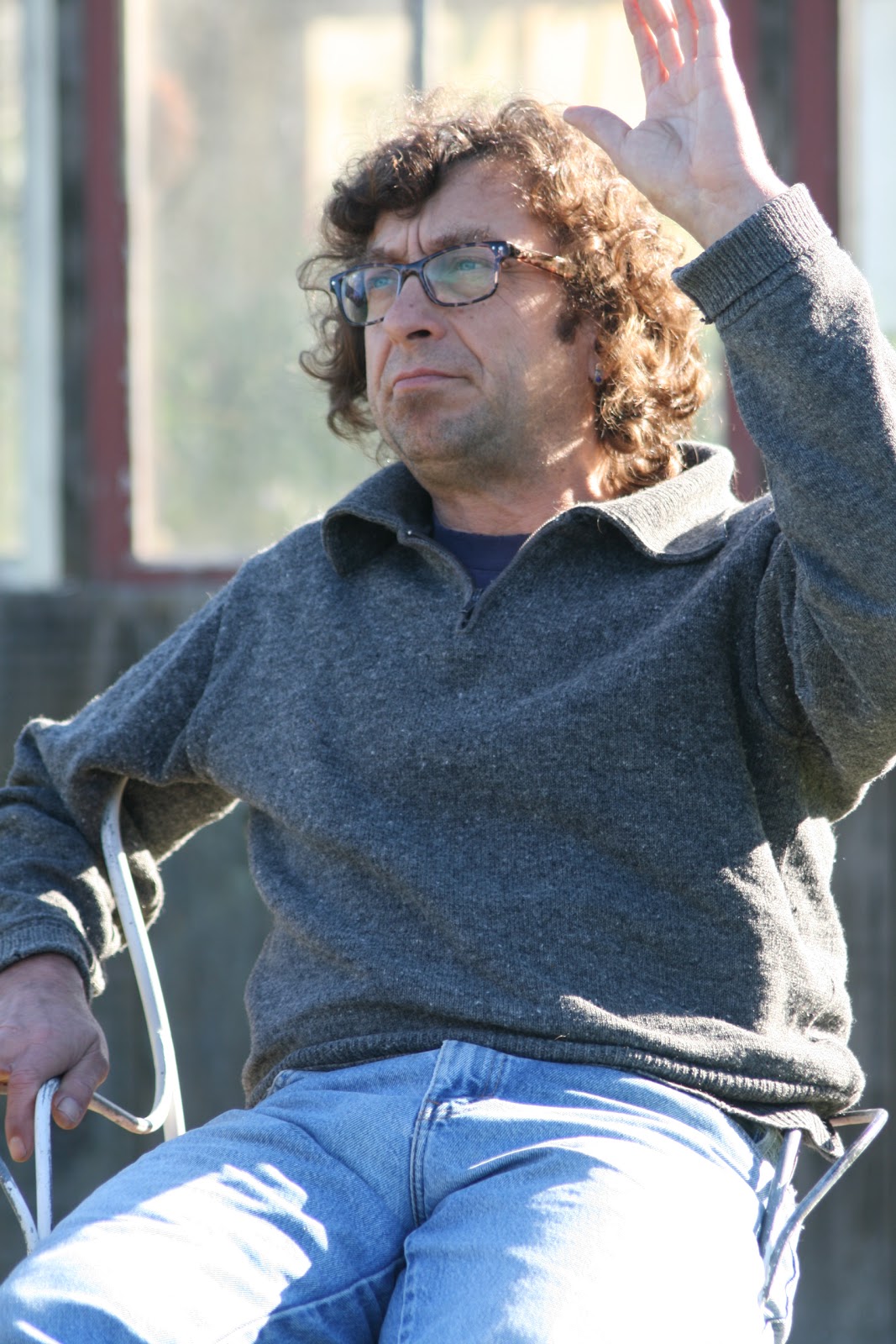
| Ross Shafer photo by Mike Alden |
This story has a life of it's own. I originally wrote this profile of Ross Shafer some time in 2009 for one publication and they declined to run it, then I pitched to another publication who then simply filed it in the circular file and finally it wound up on the Bicycle Trails Council of the East Bay's website as "Blog No 34: Interview with Pepperman" but that was two years ago. I still like the piece and I hope you will too.
By
Adam Hunt
Please,
if any one confuses Salsa founder Ross Shafer with the motivational speaker and
sometime standup comic Ross Shafer throw your bike into a bonfire then curb
stomp it. Starting in 1976 with a Proteus frame building kit Ross built his
first road bike. Shortly there after Ross built about sixty frames under the
“Red Bush” name then from 1982 to 1997 Ross ran Salsa Bicycles then sold the
company to Quality Bike Parts. Since them Ross has started his own design and
manufacturing consulting company known as Six-Nine Design. Although his clients
now range from Mesa Boogie and K&M Designs amplifiers to Steelcase office
furniture he still keeps one toe in the bike industry and his tongue planted
firmly in his cheek. From the back door of his Petaluma farmhouse you can
easily throw a rock and hit Soulcraft’s production facility.
Ross
has helped Sean Walling find his inner lugged frame builder. ” Sean approached
me and said that he had always wanted to build a lugged frame but wasn’t
entirely sure how to do it. I told him he all ready had the skills to it but it
would take some walking through “. The result is the Soulcraft Alma Pura. Named
after a local Petaluma taqueria the Alma Pura is a lugged steel fixed gear road
bike with just enough spice and just enough soul to make things interesting.
Photographer Mike Alden and I took a drive up from Berkeley to Petaluma to
spend the day on Ross Shafer’s farm, shoot some snaps, flap some gums, and put
on some road miles.Now, road isn’t dirt, dirt isn’t road, there are some dirty
roads but that’s a little different.
Initially
I tried to talk Ross into doing a mountain ride but he said his inner hippy
prevents him from getting very excited about loading up a car and driving for
30 minutes to get in a short bike ride, especially he offer’s great road riding
right out his front door. An offer that was hard to refuse.
 |
| For your viewing pleasure; sheep |
”
It’ll be hard not to, I’ve got some Scottish in me! ” Mike shouted back.
Ross
has said that his somewhat offhand manner has lent to the perception that he
was somewhat flippant at best and somewhat rude at worst. The prankster side of
Ross is still evident and as far as being somewhat short with people over the
phone, that’s something he’s sorry about.
”
Sometimes, I’d get really caught up with things or I had a deadline then I’d
get a call and I’d say, ‘ Can’t talk! ‘ and hang up. I feel really bad about
doing that and that’s something I want to apologize for “.
Mike
and I climbed up into Ross’ livery stable / office and I promptly bumped my
head on the ceiling. The room was cold, with two large open windows, electronic
bric-a-brac lay next vintage Salsa stickers, computers churned out cad/cam
displays on flat screen monitors, two guitars sat forlorn and lonely in the
corner like scolded children – maybe not the best place for an interview.
Ross
brings up the idea of going outside. Sounds good. I turned myself around and
tried to maneuver myself down a tricky ladder that led back down to the stable.
” Not the stairs you want to try to go down in a hurry, ” I said to Ross.” Aw,
come on, my fifteen-year-old cat can make it, you can too! ” Ross, Mike and I
made our way through his vegetable garden, pass the greenhouse, grabbed some
chairs and I let Ross do the rest.
Adam: ” During one of our phone
conversations you had described yourself as being ” self unemployed” but
looking at your Six-Nine Designs website it hardly looks like you’ve been idle
“.
Ross: ” Yeah, I haven’t been idle. ‘
Self-unemployed ‘ refers to the fact that I don’t want to work. (Laughs). No,
it’s just a joke. With Six-Nine Design I go through long times without having
much work. Especially with this last year. There’s been some really slow months
so sef-unemployed is what I am when I’m sittin’ around waiting for the next
customer to call up with a job that needs doing. I’m ‘ self unemployed ‘ by
choice “.
Adam: ” That definitely beats having
to be on a time clock or having to be some place at a given time “.
Ross: ” It does in a way although I’m
finding, in my post Salsa years, it’s really difficult for me to motivate
myself about certain things. It’s just me and the computer or it’s me and the
shop. There’s not a bunch of employees depending on me, there’s not a bunch of
dealers, there’s not a customer on a bike, its very different from my life in
the bike biz. Not as much of a community aspect and the motivation that comes
from that in my freelance work.”
”
I don’t have to punch a time clock but Six-Nine I’m never off work, I’m always
working, because whatever project I’m involved with is always going around in
the old noggin’. I’ll be reading a book and after reading a few pages and I
won’t know what the ____ I read because I’m still trying to figure out how I
can dimension that one weird profile in some drawing I’m doing “.
Adam: ” What kind of clients are
contacting you for Six-Nine Design? ”
Ross: ” All kinds….I’ve done a lot of
work for Mesa Boogie here in town. For them it’s mainly tool making and helping
them create work stations to help achieve better, more ergonomic production.
It’s surprising how much of the work I get comes in from the referrals of folks
I knew from the bike industry. I’d say over half of the work I’ve done since
starting Six-Nine has come in some way from old contacts in the bike industry
“.
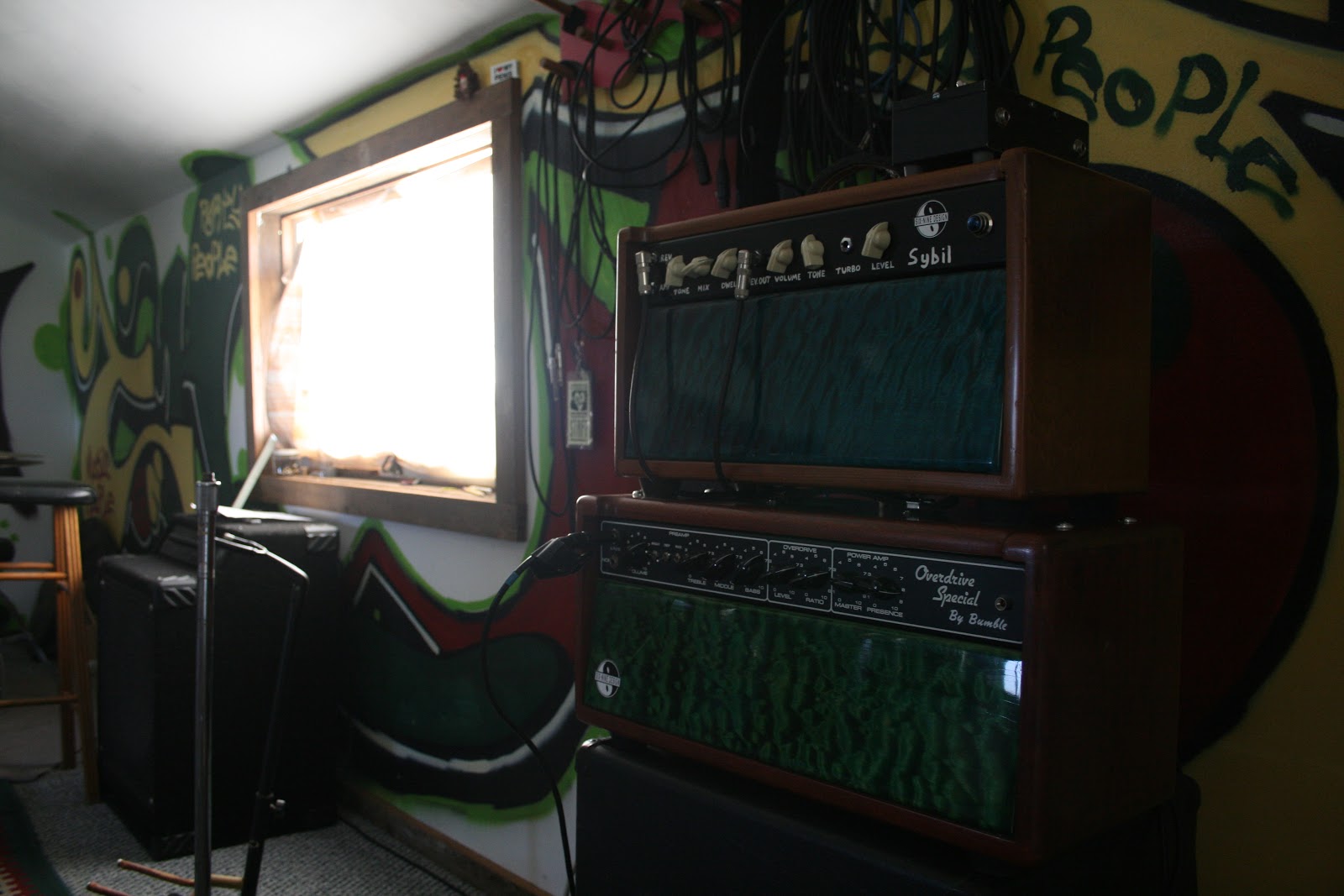 |
| Amps built by Ross |
Ross: ” That’s certainly the case for
a lot of people. It’s not so much that people are moving out of the bike
industry as people like me who have made a choice to do something different and
yes, in a lot of cases the pay is better “.
Adam: ” How big of truck filled with
money would some one have to drive up to your house to lure you back into the
bike business? ”
Ross: ” I’m doing a project for the
bike industry right now and it’s totally on spec so I’m not getting paid
anything! “(Both laugh)
”
How big of truck of money? I don’t know… I’d have to have a satisfactory
situation with people I like to work with and projects I’m really interested
in. That’s more important than the money “.
Adam: ” Obviously you’ve kept at
least one toe in the ‘ industry ‘ with your involvement with the Alma Pura
project with Soulcraft. How did that come about? ”
Ross: ” That was a fun project.
Unfortunately it hasn’t netted any sales whatsoever but it’s a cool bike. Sean
(Walling) came back from the first hand built bike show in San Jose saying, ‘
God, all those lugged bikes are so cool, it’d be cool to offer a lugged
Soulcraft’ so I said, ‘ You should just build one! ‘Sean
said, ‘ I want to offer this bike, but don’t have the time Why don’t you build
it and we’ll charge a ____ load of money in order to get you to come out of
retirement ‘.
Adam: ” Do you some times look back
at your life in the bike industry and think that was a different Ross Shafer? ”
Ross: ” It’s funny you should ask
that. I’m not sure how much of this I want on the record! ”
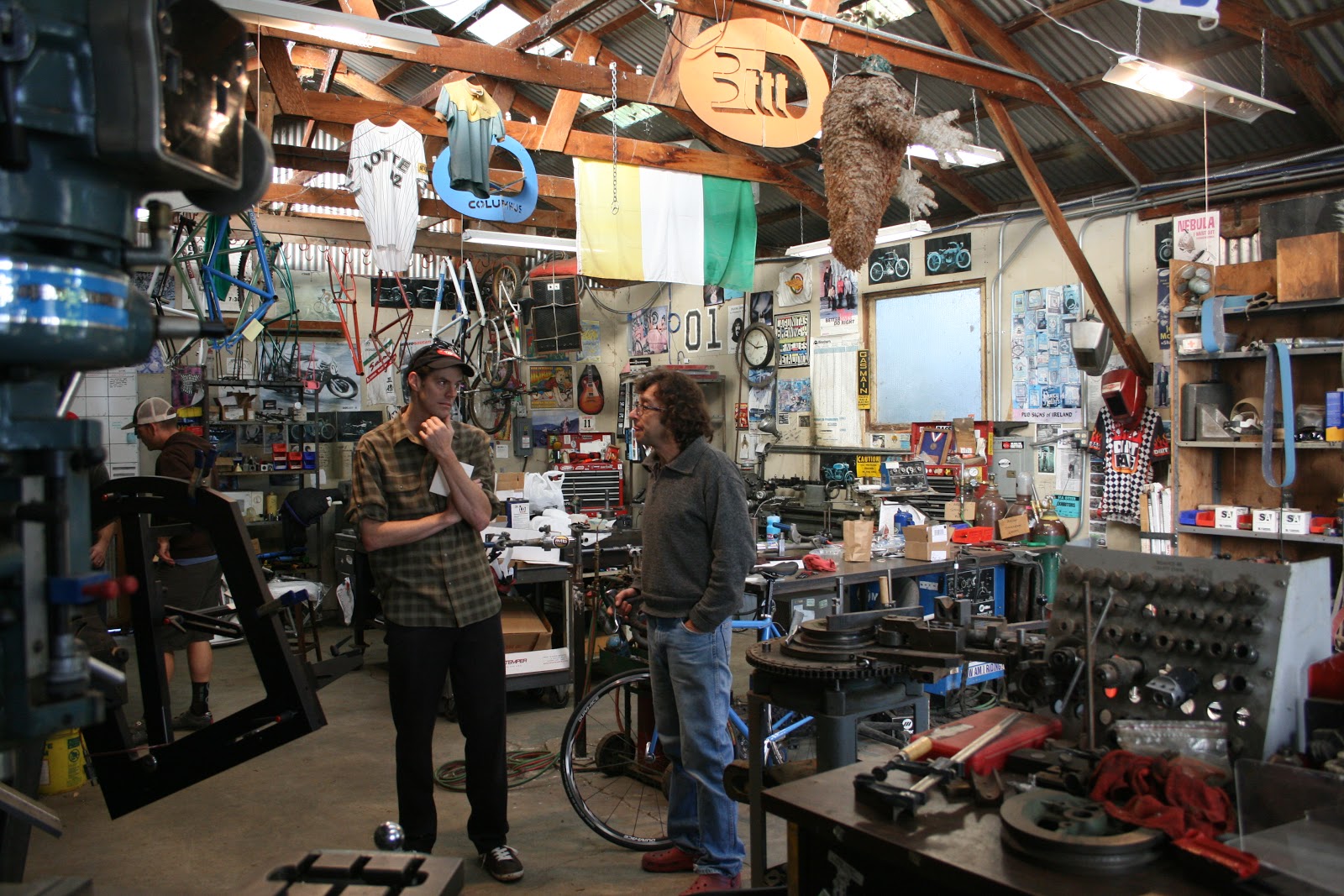 |
| Ross and Adam at Soulcraft's world headquarters |
Ross: ” The first piece of advice I
give is get a job in a bike shop. Get a job in a bike shop and learn how to
work on bikes. There’s so much education to be had by knowing what a day in the
life of a bike mechanic or a store-owner is and that’s by getting to know the
clientele – there’s no better way to get to know the market. ”
”
The bike magazines tell you nothing about the market. Absolutely nothing. No
body wants to write about the ‘real market’. Everything you read about in the
magazines are niches. There’s just so much more to it. There’s a lot of
personal relations and you have to understand the personal relations that
people have to their bicycles, any way, I can go on forever because so many
people want to bypass the bike shop step and it’s the most important part. How
can you know the industry without some knowledge of the front line…the bike
shop!”
Adam: ” You’ve worked as a
manufacture in the US but you’ve also have outsourced products from Europe and
the Far East, how ‘green’ do you think the bike industry is? ”
Ross: ” Not. Not. It’s not very
green. There’s very little manufacturing worldwide that’s very green. It’s not
necessarily the manufacturer’s fault but more societal driven, I guess. We’ve
got this big boom and it’s hip to be green now and things are accelerating at a
huge pace compared to the last… how old are you? ”
Adam: ” Forty-four “.
Ross:
” Forty-four? Holy ____! You look really young!”
Adam: ” I owe it all to rampant
immaturity “.
Ross: ” That’s what I’ve got going
for me, that’s why I don’t have too much gray hair “.
”
Where were we? No body talked about ‘green’ twenty-five years ago except
hippies. And now not every body’s a hippy but every body is talking about,
‘green’. The bike industry is no greener than the automotive industry it’s no
greener than any other industry. Arguably, the usage of the product is greener
than a car but you can say that about this chair too “.
Adam: ” I know that in particular
with a lot of the ‘alternative materials’…”
Ross: (Laughs) ” Made, in China “.
Adam: ” Maybe…”
Ross: ” Because, they can. You mean,’
those materials’? None of the materials are made in green facilities.
Steel, and aluminum are both hideously energy intensive to make and non green.
I can’t pretend to know enough to say that steel is greener than aluminum or
whatever, but there’s a reason why all of this carbon fiber stuff is being
sourced in China. (Laughs) And a lot of it’s due to environmental and working
regulations; that’s something I currently have a problem with the industry. ”
”
They promote the bike as green product and at the same time they are promoting
all this high tech wizardry so when it comes to carbon fiber bikes, the bulk of
them are being made in China. You couldn’t make it in that volume, for that
cost, in the US “.
Adam: ” Which current builders are
you excited by?”
Ross: ” There’s way too many for me
to remember all the names. For the most part I’m really excited by the plethora
of custom frames being made these days. Don Walker’s NAHBS and all its
offshoots have done a lot to bring more recognition to good builders….but these
shows also give a lot of recognition to folks who are (or maybe should be)
hobbyists as well. Anyone with the right skills and a shitload of time can
build a few awesome frames and those frames can indeed be works of art.
I
feel that the true art of framebuilding lies in one’s ability to produce high
quality, durable frames that fill the customer’s needs and desires,
functionally and aesthetically, while putting food on the table doing so. To
me, building frames and being a framebuilder are different things. I’ve built
guitars…but I’m definitely not a guitar builder".
I
wish these hand built bike shows had a central concours area where all the
builders put they’re fancy show pieces while focusing their booth space on the
product that sustains their business. That’d give the public a much more
accurate picture of what a framebuilder is….or isn’t”.
Adam: ” What I think is interesting
that a lot of people who have been involved with the bike industry have also
been extremely creative but that’s something that’s not been really touched
upon. Sky Yeager does a lot of photography, Paul Price has done a lot of
woodwork, Charlie Cunningham and Curtis Inglis have done auto restoration, and
you’ve been working with K&M and have done motorcycle restoration, do you
think there is a commonality? ”
Ross: ” The commonality is passion.
Virtually everyone you mentioned there is passionate about their profession and
their non-work interests and hobbies. For many of us making a living at
something we have no passion for is just too un-fulfilling to consider very
seriously. I can’t think of anyone I know who got into the bike biz because
they thought it’d be a stylin’, secure and financially rewarding profession.
No, most people get into the bike industry because they can’t help themselves
“.
Adam: ” You said your son, Max, has
decided to become a tattoo artist, that seems a long way from the bike world “.
Ross: ” I don’t know, there’s a lot
of tattoos on bikers these days so it’s not too far! ”
Adam: ” Yeah, but we’re not talking
about ‘ Sons of Anarchy ‘”.
Ross: ” It’s a long way from bikes
but fortunately he didn’t grow up hating bikes. I think it’s kind of a typical
thing. I definitely didn’t want to have to do anything with what my dad was
into or doing, I think that there is a little bit of that with Max. At least he
shares my politics. ”
Adam: ” Where in Southern California
did you grow up?”
Ross: ” Orange County, baby, the
Republican heart of California “.
Adam: ” Your educational background
as a frame builder is pretty well known but at what point did you realize, ‘
Hey, I can make a living at doing this! ‘”
Ross: ” I built the first frame
because I really just wanted to make a frame. I knew it wouldn’t be as nice as
the frame I lusted for but couldn’t afford (a Wizard, built by Brian Baylis and
Mike Howard). Even knowing it wouldn’t be an art piece like those Wizards, I
was still excited about learning what went into building a frame ” ” I built
the first frame and it took me three or four months to build, and realized, ‘
Holy ____! There’s so much to learn here! ‘”" After finishing the first
frame I was out on a ride with a guy and he said it was a pretty nice looking
bike (he didn’t know what he was taking about…believe me!) Where did I get
it?”’ I made it. ” Would you build me one? ‘” I said, ‘ Yeah… Sure! At some
point while building the next few frames I figured…hey maybe I can make a
living at this.”
Adam: ” What’s not well known is your
involvement in music. You’ve built a couple of guitars, a mandolin and some
amps what musicians inspire you?”
Ross: ” Ho! That’s like asking what
frame builders excite me. You know, anybody I see perform, that I see enjoying
themselves, those musicians inspire and excite me. But what specific musicians
inspire me? Jeff Beck, Stevie Ray Vaughn, Robben Ford, Steve Howe, there’s a
zillion of them. Any body who has a lot of melody and I lot of skill I bow down
to”.
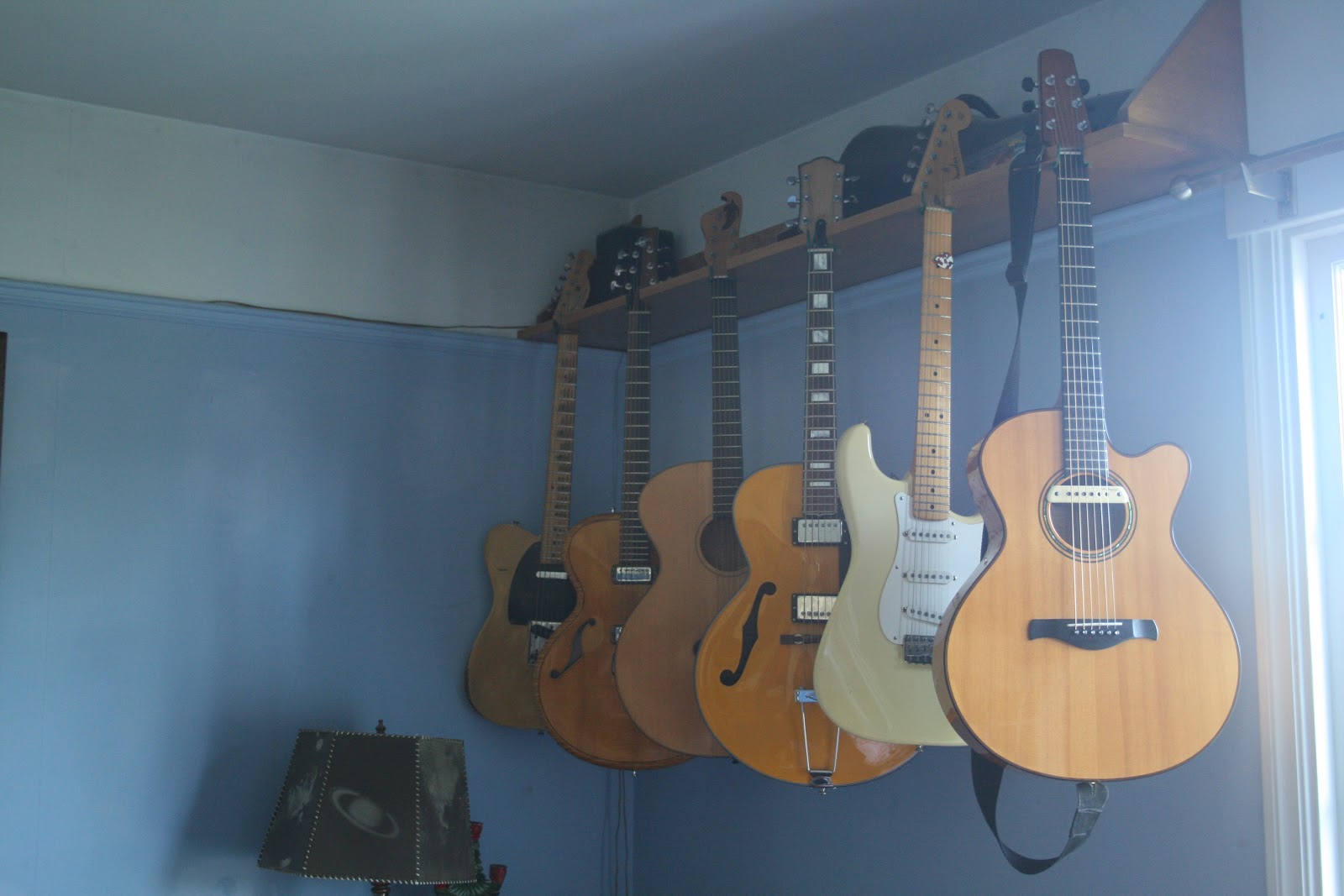 |
| Paul Safoff's old Tele stage left |
”
Paul is a hell of a player,” added Ross shaking is head as if silently
acknowledging his own self-professed shortcomings as a player. Ross was also
keen to show off two of the guitars he had made under the watchful eye of
Rohnert Park guitar builder Taku Sakashta. For those who are unfamiliar with
Taku Sakashta, Taku Sakashta may be to the guitar world what Jeff Jones is to
the bike world. Both are innovative builders, both have long lead times, both
the frames and guitars are highly sought after, and either would be a prize for
any collection.
Backing
through the kitchen we noticed some large blocks of hand made soap waiting to
be shipped out for the holidays. ” My wife Mari made it. It takes six weeks to
dry before we can send it out “. Wandering out of the house and making our way
through the parking area and past the Soulcraft production area,
Ross
lead Mike and I to yet another workshop. Along the way a panicked sheep was
struggling to free it’s head from a snarl of wire fencing. Both of Ross’ dogs
were barking and nipping at the hooves of the terrified sheep as it continued
to bleat uncontrollably. Ross shooed the dogs away, leaned over to help free
the sheep and reminded us not to try to molest it while it was trapped.
The
dogs chased the sheep down the hillside and Mike, Ross and I entered a
renovated chicken coup that’s been turned into a workshop and rehearsal studio
right next to Mary’s sewing studio. On our way out from the studio Paul
Butterfield’s guitar ace, Elvin Bishop, had written on the studio’s wall ”
Thanks Ross! Elvin Bishop ” in thanks for Ross’ lending him the use of the
studio for a recent recording project.
After
the grand tour of Ross’ farm and workshops every one suited up for a much
anticipated road ride. The air was still crisp with a November chill and the
sun was quickly disappearing over the horizon on its way to Hawaii, Wake, and
Japan. Mike and I pulled down a couple cyclocross bikes from the roof of my
aging Nissan mini truck and Ross pulled out the livery stable an incredibly
sexy red and white lugged steel Six-Nine Design fixed gear road bike.Down the
gravel driveway, through the gate, the three of us hit the road. The Sonoma
County hills have now just exchanged their brown summer coat for a green
winter’s jacket. Ross navigated us through a series of back roads and leapt
onto a westward highway still peppered with fresh gravel.
Mike
nearly takes a spill as his front wheel slides off the road and into the soft
shoulder. He rights himself after a moment then begins chasing after Ross’
wheel. For a guy in his mid fifties on a fixed gear, Ross is still able to set
a remarkably quick pace but that would soon be negated as the land lurches
upward. The highway starts to get hilly, Ross urges Mike and I to roll along as
thing start going vertical. Traffic, wind, and physical exertion make’s it
somewhat difficult to carry on a conversation but I asked Ross what he wants to
be when he grows up.
”
I’m still trying to figure that out! ” said Ross still cutting a good clip on
his fixie.
We
start to loop south, then east back towards Petaluma. The road banks downward.
Mike rockets down the highway with his usual disregard for personal safety.
Ross is next but his legs can only spin so fast downhill. He cuts it as close
to the speeding cars as he can, leaving more than a bike’s width of space
between he and soft shoulder to his right. I figure, I can pass on the right
but that would simply add to my long list of incredibly bad moves. I’m coming
up fast on Ross’ six. He can neither see nor hear me so I chance passing him on
his left. I move out onto the highway at about 40 mph only to hear the angry
blare of a horn of a passing car before I can whiz by Ross and hop back to the
safety of the bike lane.
The
road levels out and we make a left then wind our way back through some
residential streets to Ross’ place.Ross’ wife, Mari, greets us from their back
porch and asks Ross how the ride was. ” Those guys were fast! ” Ross said
stripping off his sweaty vest and wool jersey.
We
also strip out of our riding gear. Mike and I pack up to make a side trip to
Santa Rosa for dinner before making our way back down to the East Bay. Mike and
I talk about the day as we slowly creep northward in congested rush hour
traffic. ” You were really kicking up a good pace, Mike” I said.
”
I was cold! I was just trying to keep warm! ” Mike said as the cabin of my
truck slowly heated up.
”
I was just trying to keep up with you two guys! ” I said to Mike, but I’m not
sure I’m going to say that to Ross.
Fast
forward…. It’s been two years since I had interviewed Ross and a lot had
changed since then.
February
26th 2010. Ross Shafer’s friend and guitar making mentor Taku Sakashta is
working alone in his Rohnert Park California’s workshop. His back is to the
door and he’s on the phone to a client in Japan. He doesn’t hear Joshua Begley
enter the building.
Begley
is all ready on the run from the law. He had just escaped from police custody
and he needs some money to keep running. As luck would have it Begley spies
Taku’s prized Nissan in the parking lot of the workshop and Taku’s door is
unlocked. For Taku it’s a fatal mistake.
By
the time runs from the workshop Taku had been stabbed over a dozen times about
the torso and face.
One
week later Begley, a petty criminal who had two prior convictions, is leading
the Rohnert Park police in a high-speed pursuit through a residential
neighborhood and is shortly soon arrested as a result.
The
tight nit Northern California music community is stunned by the death of Taku
Sakashta. Ross and a number of other guitar builders including Tom Ribbecke,
Ervin Somogyi, Toru Nittono, Michael Dolann with David Hunt, Two-Rock and Mesa
Boogie amplifiers, immediately set up a fund raiser and trust for Taku’s widow.
Two
months after Taku’s untimely death Rohnert Park’s Sprecklels Performing Arts
Center is alive with music. The lobby area is filled with offerings from both
the music community and Ross’ connections to the bicycle world to be auctioned
off to raise money for Taku’s widow. Robben Ford and Boz Scaggs headline the
event with opening acts ranging from Tuck and Patti, and Eric Gales.
Ross
becomes a grandfather. His son Max is now grown and is working as a tattoo
artist in Berkeley California. Far from being horrified by his son’s career
choice Ross couldn’t be happier, and in fact he’s proud of his son’s
accomplishments.
With
a beautiful house, a great wife, a talented son – you couldn’t ask for more.
Life’s been good so far…
Contact Ross at Six-Nine Design
No comments:
Post a Comment